
Introducing our first Founding Athlete
When we started Plantiga, our north star was simple: take a dataset we believed was one of the best lenses into human health and use the insights it produced to make someone's life better. Today, we're announcing the clearest expression of that mission we've ever had.
As Plantiga has grown, we've realized there's a unique opportunity to partner with athletes who don't just use the product — they help shape what it becomes. We call this group Founding Athletes, and Gabe Landeskog is our first.
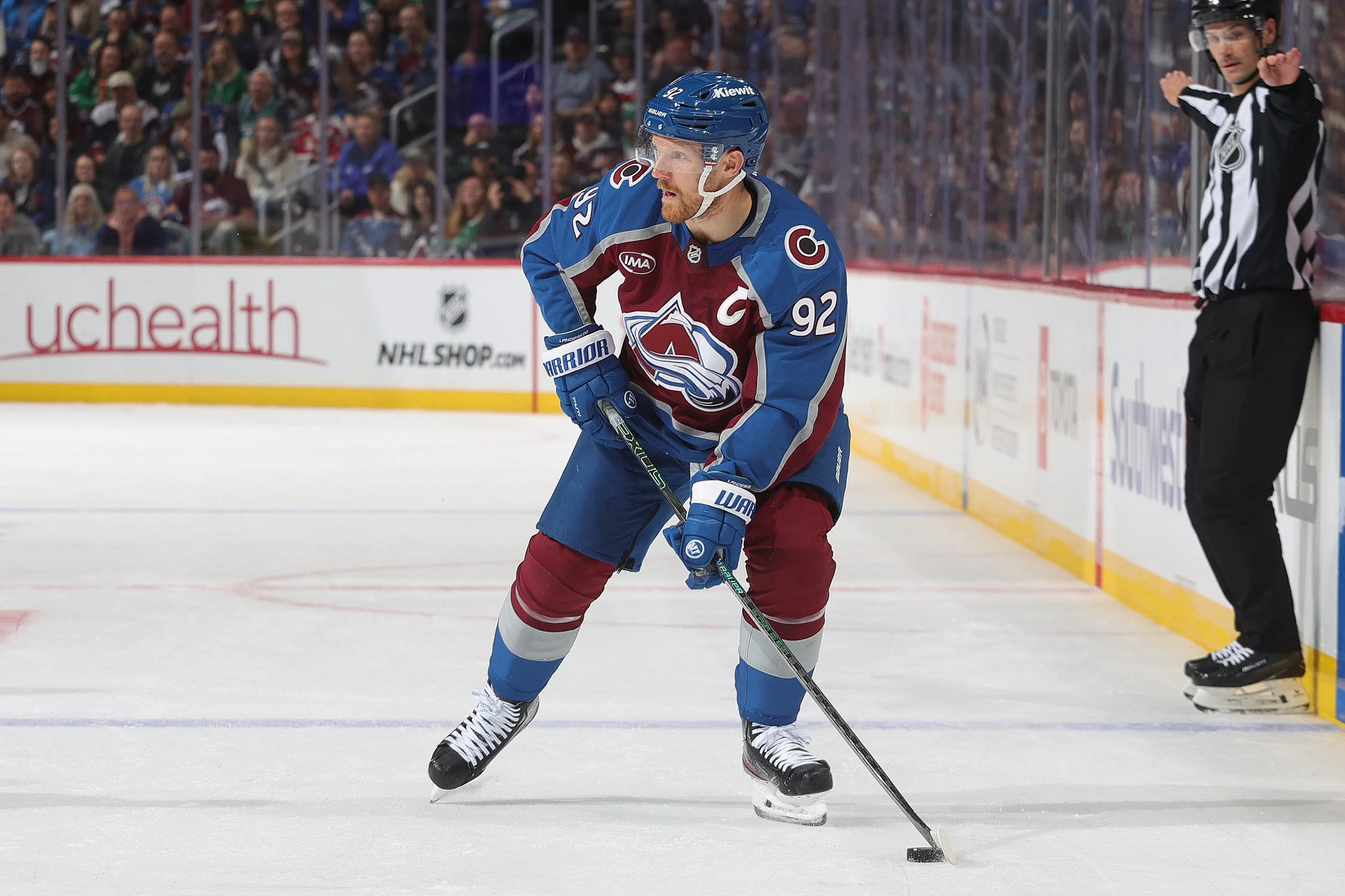
Landeskog
A founding athlete to us is someone who has lived the technology, stepped into the work, and now helps define where it goes. That means being a user and a client, an investor, a voice helping us tell our story — and letting us share theirs.
Gabe joins to help push Plantiga deeper into hockey: a sport with a movement profile unlike any other. The mechanics of skating on ice alongside movements over land create a dataset with layers that we've only begun to understand. There is no sport we are more excited to build for.
“We have never had the privilege of watching somebody’s journey this closely. All the ups and downs. All the progressions and regressions and stagnations. It was a feat of the human spirit.”
Here’s the story of how it happened.
A journey nobody had taken before
In 2020, a skate blade cut Gabe's lateral quad during the NHL playoff bubble in Edmonton. The laceration created an abnormal loading pattern that created a cartilage lesion — a hole — behind his kneecap. After two smaller procedures failed to hold, he underwent an osteochondral allograft: which is a surgery that removes the damaged cartilage and plugs donor tissue in its place. Substantial surgery in any context. In hockey, it had never been done with a player returning to their career on the other side.
"It's a long, grueling road of rehab and recovery," Gabe said. "A surgery that had not been done in my profession — no hockey player had ever done it and been able to really resume their career afterwards."
We came into the picture at the start of 2024, more than three years into that road. Before Plantiga, recovery had been managed entirely on feel — symptom reports, subjective check-ins, and educated guesswork. As Gabe described it: “We would do a certain protocol for a few weeks and then we would do another one for a few weeks. Then we would try and add something else. It felt very much like a trial and error process." There were no numbers. There was no map.
Skate blade cuts outer quad muscle during the NHL playoff bubble in Edmonton. Abnormal loading pattern follows, creating a cartilage lesion behind the kneecap.
Leads the Colorado Avalanche to the Stanley Cup — the final game of his career before a multi-year absence. The knee holds just long enough.
After two smaller procedures fail, donor cartilage replaces the lesion behind the kneecap. No NHL player had ever returned to their career after this surgery. There was no roadmap.
"It was a surgery that had not been done in my profession — no hockey player had ever done it and been able to really resume their career afterwards."
— Gabe LandeskogAfter three years of symptom-based guesswork, sensor insoles replace instinct with data. Loads from every walk, skate, and training session feed into a dashboard. Morning dog walks become the daily baseline. The team can finally see what the knee is doing.
"The pre-Plantiga experience was very much trial and error — no real numbers, just how's it feeling. Once Plantiga came in, we had actual data points: right versus left, asymmetries, hard numbers on how we were doing."
— Gabe LandeskogProgression through each training stage — walking, rucking, solo skating, team practice, full contact — only when the data confirms readiness. Overreach shows up the next morning, not two weeks later. Compensation patterns invisible to the eye are caught in the numbers.
"As an athlete, you're competitive — if you wake up feeling good, you're going to throttle down. Plantiga saved me from gambling with my health."
— Gabe LandeskogFirst game: Colorado Avalanche vs Dallas Stars. The arena erupts — "Landy! Landy!" Three nights later, his first goal in 1,035 days. The only player in NHL history to return from an osteochondral allograft of the kneecap.
"They're part of my equipment now — right alongside my skates and pads."
— Gabe Landeskog, on wearing Plantiga sensors every gameHow the technology made the difference
The core problem Plantiga solved wasn't physical — it was informational. Gabe could skate, feel fine, and then be sidelined for two weeks without understanding why. The body was giving signals, but nobody could read them in real time.
With sensor insoles in both his skates and training shoes, Gabe's biomechanical data flowed continuously his personal health and performance team, Marcin Goszczynski and Dr. Matt Jordan — covering every activity, every day, wherever he was. His morning and evening dog walks became the baseline: a reference point that revealed exactly how each training session was affecting the knee before the next one began.
“There were times where the numbers would come in slightly off and I was feeling okay — and then a few days later, there was something actually going on. And then there were times where I was feeling a little achy, but the numbers would support saying everything’s okay, we’re on a nice trajectory going up and to the right.”
The result was a recovery that adapted daily — not to a static protocol, but to exactly what Gabe's body was communicating. Every day dialled in. Every threshold respected. And over months, his capacity grew.
There was also an unexpected emotional benefit: the relief of not having to explain everything in words. "When you're rehabbing, you run out of words, you run out of adjectives," Gabe said. "The comfort of not having to explain everything — and actually just saying, hey, log into Plantiga, look at my numbers — that was a very good feeling. It made me feel more supported.”
What comes next
Gabe continues to wear his sensors for every skate and every game — monitoring the cumulative toll of a full NHL season, tracking asymmetries across the body, and reviewing how practice loads compare to game loads as the season builds.
“It’s sort of like forgetting to brush your teeth in the morning - it kind of ruins your day if you don’t have them.”
The data still matters. And the collaboration between athlete, practitioner, and technology continues — not as a rehab story anymore, but as an ongoing performance story.
Gabe sees the future of this technology extending well beyond his own career. He imagines using Plantiga as a bridge between the locker room, strength coaches, sports science staff, and coaching staff — catching offloaded joints before they flare up, informing practice schedules across a grinding season, and giving athletes ownership of their own health data alongside sleep, nutrition, and treatment protocols.
"I think as athletes continue to understand how valuable the data is — we wear heart rate monitors, we wear sleep trackers — this is another tool that will become mainstream," he said.
“Own your data, understand it. Once athletes really start taking pride in seeing the numbers from games and practices, it’ll be a huge tool for teams and athletes.”
Watching Gabe compete at an elite level again after one of the most complex rehabs in professional sport is the answer to the question we keep asking ourselves: does this actually make someone's life better?
In this case, it’s a resounding yes.