
How Matt Redekopp, a Performance and Longevity Physiotherapist, stopped estimating and started measuring.
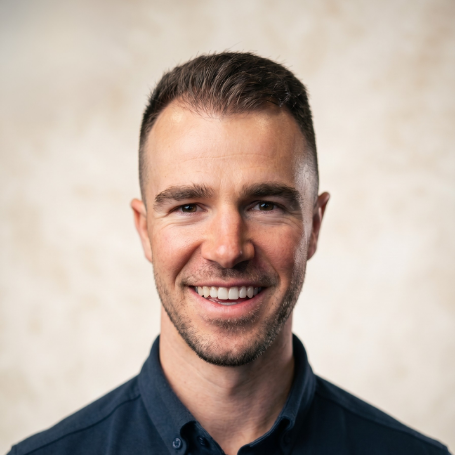
Physiotherapist
Matt Redekopp
Setting
Sports Physio Clinic · Longevity Clinic
Different clinics, same gap
Matt Redekopp splits his week between two clinics in British Columbia — a longevity practice focused on healthy aging, and a sports physiotherapy clinic where athletes grind through ACL reconstructions and return-to-sport timelines. The individual patient profiles couldn't look more different: a 68-year-old working to walk confidently after a hip replacement vs. a 22-year-old trying to get back on the field. These patient profiles share very little on the surface, but the gap in his assessments showed up the same way in both rooms.
Sports physio clinic
22 years old
Goal
Return to field after ACL reconstruction
Progress measured in
Longevity clinic
68 years old
Goal
Walk confidently after hip replacement
Progress measured in
Different on the surface — but the gap in assessments showed up the same way in both rooms.
Matt has spent years learning to read bodies — and his clinical instincts are well-trained. But instinct isn't a number, and numbers are often what patients, and the coaches and kinesiologists around them, needed to see. Some people need to be held back. And some people need to be let go — but they needed to actually see it to believe it.
“I can watch someone walk and sense that something is off. I can hear a foot slapping the treadmill belt and know that they are struggling with eccentric control. The issue is being able to show the patient in a way that they get it.”
What the data unlocked
When Matt introduced Plantiga into his assessments, the asymmetry data was the most compelling. Left-versus-right imbalances he'd been estimating were suddenly quantified — load through each limb, takeoff and landing metrics, individual ground contact times. The return-to-sport conversations changed immediately. Athletes instinctually understand asymmetries and imbalances — but seeing the exact numbers removes any room for doubt.
“It’s not one number. It’s swing time, stance time, G-load, left versus right. There’s so much there.”
The full baseline protocol — walk, run, sprint, two-legged hop, single-leg hop, squat jump, double leg jump for distance — takes five minutes and fits inside any appointment. Colour-coded thresholds translate the complexity of the data into something patients can immediately understand and act on. Matt says, "I can show someone they're in the red and explain what that means and then the next week, they come back wanting to see if it moved."
That visibility changes behaviour in ways that ripple outward. Patients do their homework because they can see what it produces. And the practitioners around them — strength coaches, kinesiologists, exercise physiologists — take notice. "They get fired up," he says. "Because their patients are actually following the program. And when we share the data, everyone is speaking the same language."
What the numbers say
Two RCMP (Royal Canadian Mounted Police) officers recovering from complete ACL tears became the clearest proof of what that language can do. Both arrived hesitant and under-confident. For injuries of that severity, the mental recovery often lags far behind the physical — the fear of re-injury, the ambiguity of knowing when it's actually safe to push harder. Early walking data showed both officers loading ~30% more through the injured limb. In the red.
“I showed them what that meant. And then the next week, we looked again. Down to 30%. Then 10%. Then essentially even.”
Each threshold reached became permission to progress — walk to jog, jog to sprint then bilateral to single-leg hops and jumps.
“I’d say: here’s what I’m seeing, here’s what the data says — how do you feel about taking the next step? And as the numbers improved, the answer was consistently yes.”
One officer returned to duty and broke the record on the RCMP's physical fitness test. The other was back on a physically demanding unit well ahead of schedule — sooner than his employer had anticipated.
“Getting back sooner than anyone expected — that mattered to him enormously.”
Improvement, made visible
The same principle holds at the longevity clinic, just with different stakes and a different patient in the chair. Where an athlete needs data to trust their body again, an older patient often needs it to believe that meaningful improvement is possible at all.
“Sometimes I’ll ask a patient in their fifties if they think they can hop on their toes,” Matt says. “They’ll say, of course — I played junior hockey, I played soccer. And then they try, and they can’t. That’s not a failure. That’s the beginning of the conversation.”
What follows — the tracking, the small weekly gains, the moment a number finally turns green — tends to land differently than any amount of encouragement could on its own.
“They’re not just doing the work on faith. They can see what it produces.”
Whether the goal is breaking a fitness test record or walking to the mailbox without worry, the data does the same thing on both sides of Matt's week: it makes progress visible, personal, and hard to argue with.
The practice he’s building
For Matt, objective data was never about replacing clinical judgment. It was about giving that judgment somewhere to land — something concrete to point to, track, and build on together with the patient.
“I’m already telling them what I see. Now I can show them. And then we can track it. That changes everything.”
That philosophy runs through every appointment, every clinic, every patient population he serves. And with Plantiga embedded in his workflow, the conversation between what a practitioner observes and what the data confirms has become the foundation of how he practices and how his patients move forward.